Korean OTC medicine · Reference information
Esroban Ointment
에스로반연고
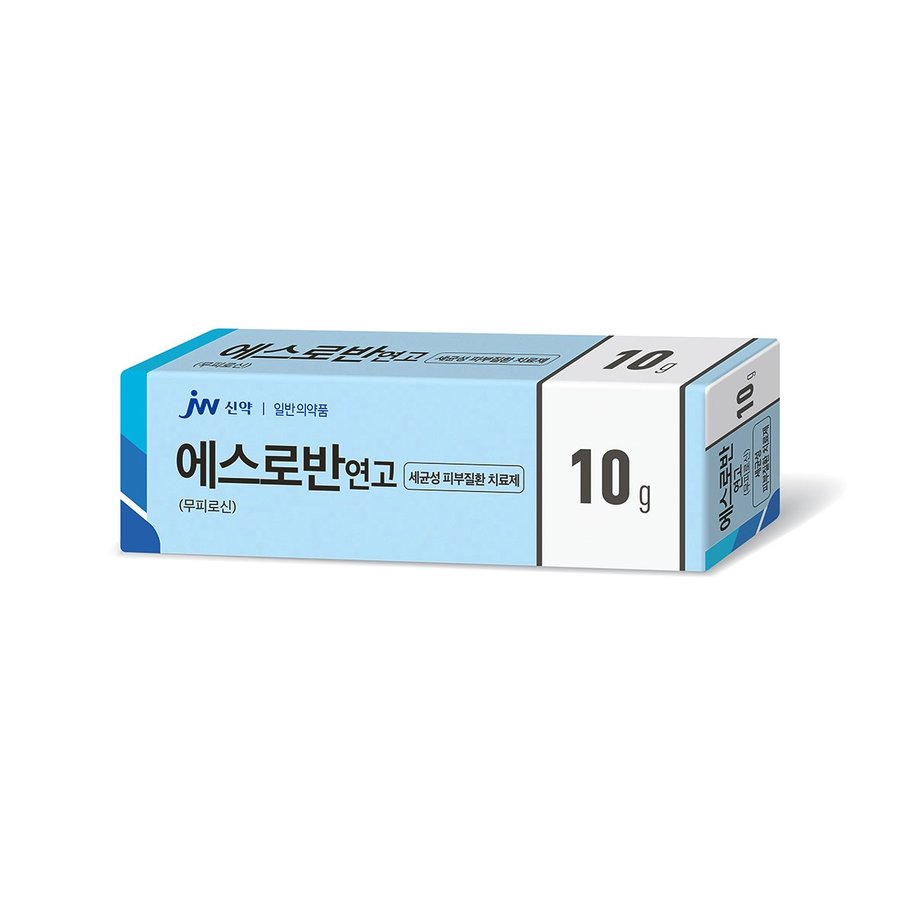
- Category in Korea
- General (OTC) medicine (일반의약품, Korean category)
- Manufacturer / marketer
- JW Shinyak (제이더블유신약)
- Active ingredients and amounts
- In 1 g: Mupirocin 20mg (potency)
- MFDS item code
- 199902738
- Approval date in Korea
- Mar 3, 1999
Approved indications in Korea: "bacterial skin infections (impetigo, folliculitis, etc.)".
Please note
- This medicine is approved in Korea; its approval status in other countries may differ. This page does not recommend buying or using it.
- The English text is our pharmacy's reference translation. The Korean original (the text approved by Korea's Ministry of Food and Drug Safety, MFDS) is authoritative. The translation neither recommends use nor indicates approval or approved indications in any other country.
- Korean law does not allow mail-order sales of medicines, so we do not sell medicines online or ship them.
- If you have a medical condition, are taking other medicines, are pregnant or breastfeeding, or the product is for a child, always consult a pharmacist.
Indications (as approved in Korea)
The English is our pharmacy's reference translation. It does not show indications approved in any other country.
1. Susceptible organisms: most organisms that cause skin infections, such as Staphylococcus aureus including methicillin-resistant strains, other staphylococci and streptococci; Gram-negative bacteria such as Escherichia coli and Haemophilus influenzae
2. Indications
1) Bacterial skin infections such as impetigo, folliculitis, furunculosis and infected eczema
2) Bacterial skin infections in injuries and burns
Show the Korean original
1. 유효균종 : 메치실린 내성균주를 포함한 황색포도상구균(포도알균), 기타 포도상구균(포도알균), 연쇄상구균과 같은 대부분의 피부감염증의 원인균, 대장균 및 인플루엔자균과 같은 그람음성균
2. 적응증
1) 농가진(고름딱지증), 모낭염, 종기증, 감염성 습진과 같은 세균성 피부 감염증
2) 외상 및 화상에서의 세균성 피부 감염증
Dosage and administration (as approved in Korea)
The English is our pharmacy's reference translation. It does not show indications approved in any other country.
Apply a small amount to the infected area 2–3 times a day for 10 days. If necessary, the treated area may be covered with a dressing or sealed (occluded).
Show the Korean original
감염부위를 1일 2-3회 10일간 소량을 바른다. 필요한 경우 바른 부위를 드레싱하거나 밀봉할 수 있다.
Precautions for use (as approved in Korea)
The English is our pharmacy's reference translation. It does not show indications approved in any other country.
1. Do not administer to the following patients.
1) Patients with hypersensitivity to this medicine, its ingredients or other ointments containing polyethylene glycol, or a history thereof
2) Patients with renal disease (polyethylene glycol can be absorbed through open wounds and damaged skin and is excreted via the kidneys.)
3) Pregnant women or women who may be pregnant
4) Breastfeeding women
2. Administer with caution to the following patients.
Do not use it for long periods on exposed open wounds or damaged skin (in animal studies, the evidence on safety regarding reduced immune function is insufficient).
3. Adverse reactions
1) Skin hypersensitivity reactions such as burning sensation (a hot, flushing feeling), stinging (a pricking pain) or pain, itching, rash and erythema (red spots) may occur due to mupirocin or the ointment base.
2) Nausea, dry skin, tenderness (pain when pressed), edema (swelling), contact dermatitis and increased exudate may occasionally occur.
3) Systemic allergic reactions have rarely been reported.
4. General precautions
1) If hypersensitivity, or severe local irritation, itching, rash, etc. caused by this medicine appear, stop using it, wash the ointment off the skin thoroughly, and consult a doctor or pharmacist to choose another method of treating the infection.
2) When using this medicine, to prevent the emergence of resistant bacteria, etc., in principle confirm susceptibility and use it only for the minimum period necessary for treatment.
3) As with other antibiotics, prolonged continuous use (repeated use) of this medicine may cause overgrowth of microorganisms, including fungi.
4) If no improvement appears after 3–5 days of use, consult a doctor or pharmacist and reconsider the use of this medicine.
5) When using this medicine on the face, take care not to get it in the eyes.
6) No adverse reactions affecting the ability to drive or operate machinery have been identified.
5. Interactions
When this medicine is used at the same time as various other medicines, it may be diluted, so that its antibacterial action decreases and its stability may be lost.
6. Use in pregnant and breastfeeding women
1) There are no adequate data on the use of this medicine in pregnant women. Teratogenicity was not observed in animal studies, but because the results of animal studies cannot predict the response in humans, do not use this medicine in pregnant women or women who may be pregnant.
2) There are no adequate data on the use of this medicine during lactation in humans and animals. It is not known whether it passes into breast milk, so stop breastfeeding while this medicine is being administered.
7. Treatment of overdose
The toxicity of this medicine is very low. In case of overdose, give symptomatic treatment (treatment according to the symptoms), such as washing the area clean.
8. Precautions for application
1) This medicine is for external use only.
2) Do not use this medicine on mucosal surfaces such as the eyes and nose. Stinging (a pricking pain) and dryness have been reported with use inside the nasal cavity.
3) This medicine is not suitable for use at sites where central venous cannulation is to be performed.
9. Storage and handling precautions
1) Keep out of the reach of children.
2) Transferring the medicine to another container may cause accidents or is undesirable for maintaining its quality; take care to avoid this.
3) Discard any medicine left over after treatment.
Show the Korean original
1. 다음 환자에는 투여하지 말 것
1) 이 약 또는 이 약의 성분이나 폴리에틸렌글리콜을 함유하는 다른 연고제에 과민증 및 그 병력이 있는 환자
2) 신질환 환자(폴리에틸렌글리콜이 찢긴 상처 및 손상된 피부를 통해 흡수될 수 있으며, 신장(콩팥)을 통해 배설된다.)
3) 임부 또는 임신하고 있을 가능성이 있는 부인
4) 수유부
2. 다음 환자에는 신중히 투여할 것
노출되어 찢긴 상처 및 손상된 피부에 장기간 사용하지 않는다(동물실험에서 면역기능 저하에 관한 안전성 증거가 불충분하다).
3. 이상반응
1) 무피로신 또는 연고기제로 인하여 작열감(화끈감), 자통(찌르는 것 같은 아픔) 또는 동통(통증), 가려움, 발진, 홍반(붉은 반점) 등의 피부과민반응이 나타날 수 있다.
2) 때때로 구역, 피부건조, 압통(누르는 통증), 부종(부기), 접촉성 피부염, 삼출물 증가가 나타날 수 있다.
3) 드물게 전신적인 알레르기 반응이 보고되었다.
4. 일반적 주의
1) 이 약으로 인한 과민증 또는 중증(심한 증상)의 국소자극, 가려움, 발진 등이 나타날 경우에는 사용을 중지하고, 피부에서 연고를 깨끗이 씻어낸 후, 의사 또는 약사와 상의하여 감염 치료를 위한 다른 방법을 선택한다.
2) 이 약의 사용에 있어서 내성균의 발현(드러냄) 등을 방지하여 위하여 원칙적으로 감수성을 확인하고 치료상 필요한 최소기간만 사용한다.
3) 다른 항생물질과 같이 이 약을 장기 연용(계속 사용)하는 경우에는 진균(곰팡이) 등을 포함하여 미생물의 과다증식을 유발할 수 있다.
4) 3∼5일간 사용 후 개선효과가 나타나지 않으면, 의사 또는 약사와 상의하여 이 약의 사용을 다시 고려한다.
5) 이 약을 얼굴에 사용하는 경우에는 눈에 들어가지 않도록 주의한다.
6) 운전이나 기계조작능력과 관련된 이상반응은 확인된 바 없다.
5. 상호작용
이 약과 다른 여러 약물을 동시에 사용할 경우, 희석(묽게 함)되어 항균작용이 감소되고 이 약의 안정성이 소실될 수 있다.
6. 임부 및 수유부에 대한 투여
1) 임부에서의 이 약의 사용과 관련된 적절한 자료가 없다. 동물실험에서 최기형성(기형유발성)은 나타나지 않았으나, 동물실험 결과로 인체내에서의 반응을 예측할 수는 없으므로 임부 또는 임신하고 있을 가능성이 있는 부인에게는 이 약을 사용하지 않는다.
2) 수유 중인 사람과 동물에서의 이 약의 사용과 관련된 적절한 자료가 없다. 유즙으로의 이행여부는 알려져 있지 않으므로 이 약의 투여 중에는 수유를 중단한다.
7. 과량투여시의 처치
이 약의 독성은 매우 낮다. 과량 투여한 경우에는 해당 부위를 깨끗이 씻는 등 대증요법(증상별로 치료하는 방법)을 실시한다.
8. 적용상의 주의
1) 이 약은 외용으로만 사용한다.
2) 이 약은 눈, 코 등의 점막 표면에 사용하지 않는다. 비강(코안)내에 사용시 자통(찌르는 것 같은 아픔) 및 건조의 발생이 보고되었다.
3) 이 약은 중앙정맥 삽관법을 시행할 부위에 사용하기에는 적합하지 않다.
9. 보관 및 취급상의 주의사항
1) 어린이의 손이 닿지 않는 곳에 보관할 것
2) 다른 용기에 바꾸어 넣는 것은 사고원인이 되거나 품질 유지면에서 바람직하지 않으므로 이를 주의할 것
3) 치료 후 남은 약은 폐기할 것
Source: approval details on 의약품안전나라, the drug information site of Korea's Ministry of Food and Drug Safety (MFDS) (original page, checked Sep 21, 2026). Product images are taken from each manufacturer's or brand's official website, and the source is given for each image. If you hold the rights to an image and have concerns, please let us know and we will respond promptly.